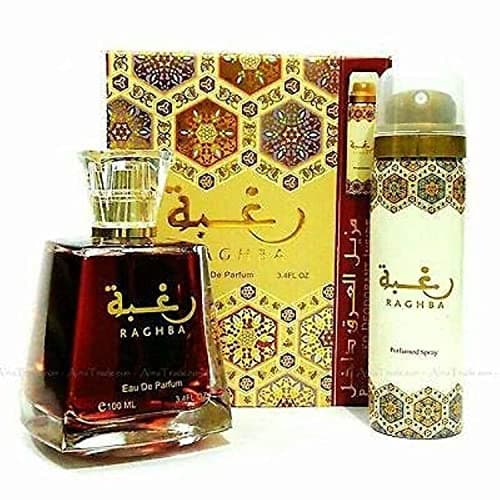
Buy it if you want a warm, sweet, long-wearing cold-weather fragrance and you do not want to spend real money finding out whether you like the genre. Raghba is one of the best value-per-hour-worn bottles we have ranked. It is sugar and incense over a vanilla-and-oud base, it is unisex, it stays put for most of a day, and it costs about what a cinema ticket costs. What it is not is subtle, office-safe, or a signature scent, and it is not the oud bomb the word "oud" on the box implies.
The other half of this review is a warning that has nothing to do with how it smells: there are at least five live listings using the word Raghba, two of them are a different fragrance, and one of them is a different company. Getting the right bottle is genuinely the hard part here.
What the house actually publishes
Lattafa's own product page gives the pyramid as sugar up top, incense in the heart, and vanilla, oud, musk and sandalwood in the base. It is filed as an amber-vanilla, classified unisex, sold as an eau de parfum, and listed at 100 ml. The house page also describes a set containing a 3.4 oz eau de parfum spray and a 1.7 oz deodorant spray — which matters, and we come back to it below.
Two things that page does not say, which we are not going to invent: it publishes no launch year for Raghba, and it publishes no concentration percentage. We have seen launch dates for this bottle quoted confidently in several places and could not tie any of them to a source we trust, so there is no year on this page.
A note on the pyramid itself: three of the four base materials are heavy, and the top of the list is a single word. "Sugar" as a top note is not really a note at all — it is a statement of intent. This is a fragrance with almost nothing happening at the top and everything happening at the bottom, which tells you more about how it wears than any adjective will.
We do not run a lab and we have not had this fragrance analyzed. What follows is a judgment compiled from that published composition, the concentration class, and aggregated owner reporting — which is what every verdict on this site is, and what our methodology page says outright.
How it smells
The first ten minutes are the sweetest part of the wear and the least interesting. Raghba opens almost candied — that sugar note is not decorative — and if you spray it on paper in a shop and walk away, you will think it is a one-dimensional dessert. It is not. The incense arrives quickly and does the single most important job in the composition: it dries the sugar out and gives the whole thing a faintly smoky, resinous edge that keeps it from reading like a bakery.
The back half is where the money is. Vanilla, sandalwood and musk make a soft, warm, slightly powdery base, and the oud sits underneath supporting it rather than leading. If you are coming to this bottle expecting the dry, leathery, medicinal profile of a traditional Gulf oud, you will be disappointed, and we would rather tell you that now — our guide to what oud smells like sets out the three different things people mean by the word, and Raghba is firmly the approachable one. The musk in that base is doing structural work too: it is a fixative, and it is part of why this fragrance does not quietly disappear after two hours like most things at this price.
The register, if you want it in one phrase: warm, cozy, sweet-smoky and a little old-fashioned in a good way. It smells like a thing a grown-up chose, not like a thing marketed at a teenager.
Performance
This is the reason it sells. Raghba is an eau de parfum built on four heavy base materials, and it performs like one — all-day longevity by aggregated owner reporting, with genuine sillage for the first several hours. In our scoring it lands at the top of the longevity and value columns and near the bottom of the versatility column, which is an accurate summary of the whole bottle.
Practical consequence: under-spray it. Two is probably enough and three is plenty. This is a fragrance that rewards restraint and punishes enthusiasm, and the most common complaint about it in the wild is really a complaint about over-application. Our spray-count guide goes through how to calibrate that, and how to make cologne last longer covers the application side.
Which Raghba are you actually buying?
This is the section we wish existed when we first looked this bottle up. A live product search on the day this review was written returned all of the following, every one of them purchasable:
Raghba (unisex eau de parfum, 100 ml) — the standalone bottle, and the one this review is about. It is what the buy button on this page points at.
Raghba 2-piece set (unisex)— the same eau de parfum plus a 1.7 oz perfumed deodorant spray. This is the format Lattafa's own product page describes. It is not a different fragrance and it is often priced within a couple of dollars of the standalone bottle, so it is frequently the better buy; just know what you are getting.
Raghba for Men (2-piece set)— a separate listing with "for Men" in the title. We are not going to tell you how it smells or whether it is the same juice in different marketing, because Lattafa does not publish a page for it that we could find, and guessing is not a service.
Raghba Wood Intense— sold in both a "for Men" and a "for Unisex" listing, and this is the one that catches people. It is a different fragrance, not a size or a bundle. We asked Lattafa's own site for it on the day of writing and lattafa.com/products/raghba-wood-intense returned a 404, so its composition cannot be sourced from the house. We are therefore naming it and nothing more: no note list, no verdict, and no buy link, on the same principle we applied to the unsourced Rabanne flankers on our Rabanne ranking. If you want Raghba, read the full product title before you click.
A Raghba from a different house entirely — at least one other Arabian house sells a fragrance under the same name at a much lower price in a smaller bottle. Check the brand, not just the word. The broader version of this problem is covered in how to spot fake cologne and where to buy cologne online.
The "what is Raghba a dupe of" question
It is one of the most common things people type after the name, so here is a straight answer: we are not going to name one. Not because the question is silly — it is a completely reasonable thing to want to know — but because every source we can find that names a specific original for this bottle is a retailer or affiliate blog, and they do not agree with each other. This site has now declined to publish three separate dupe pages for exactly this reason across eight content runs, and the standard does not change when the page happens to be a review.
What we will say is the useful part. Raghba sits in the sweet-amber-vanilla lane that a lot of expensive niche fragrances also occupy, which is why the comparison instinct exists at all, and the honest way to shop that lane is by profile rather than by clone claim. Our guide to what a fragrance dupe actually is explains why "smells like" claims are so unreliable, and the dupes hub only carries the three pairings we could substantiate.
Who should skip it
Three groups, plainly. Anyone who needs one bottle for everything. This is a cold-weather evening fragrance. It is too sweet for July and too loud for a shared office — our office ranking contains nothing like it on purpose. Anyone who dislikes sweet fragrances. There is no light-handed interpretation of Raghba available; the sugar is the premise. Anyone who actually wants to smell oud. The agarwood here is scaffolding under a vanilla, not the headline, and if the reason you are shopping is that you want the real material in front, Oud for Glory is the bottle in this house that delivers it.
What it costs, and what that buys
Raghba lives in the cheapest tier this site covers — the same bracket as the rest of the Gulf-house eau de parfums, well under the entry price of any designer bottle. The live price is on the buy button above, stamped with the date we read it, and we do not quote prices in prose because they move. What is worth saying is the thing a number would not tell you: at this tier, performance like this is not typical. Most cheap fragrance is cheap because it is weak. This one is cheap because the house does not spend money on advertising, and it performs like a bottle costing several times more. That gap is the entire argument for the Arabian value tier, and it is laid out across our Arabian ranking and the Lattafa house ranking.
How it compares to the rest of the house
Raghba is the warm, incense-sweet corner of the Lattafa line. If you are deciding between it and the two bottles that get recommended more often: Khamrah is the spiced cinnamon-and-dates gourmand and the louder, more complimented fragrance; Oud for Glory is the saffron-and-agarwood one and the actual oud of the three. Raghba is the simplest and the cheapest, and the one that asks least of the wearer. If you want those decisions made side by side, read Khamrah vs Oud for Glory and Khamrah vs Asad, and is Lattafa a good brand answers the question underneath all of them.
Whether the house is worth trusting on notes
Mostly, with one caveat this site has documented. Lattafa publishes note pyramids for most of its catalog, which is more than many houses at this price do, and the Raghba page carries a single consistent list — no contradiction, which we checked specifically. That is not universal: the house publishes two disagreeing note blocks for Oud for Glory and for Ameer Al Oudh Intense, and the Oud for Glory review documents it. Where the house publishes a clean list, as here, we use it; where it does not, we say so.